Insights Article

Our Preferred Contracting Model Is Now the Federal Standard

The call for fixed-price contracting and measurable outcomes

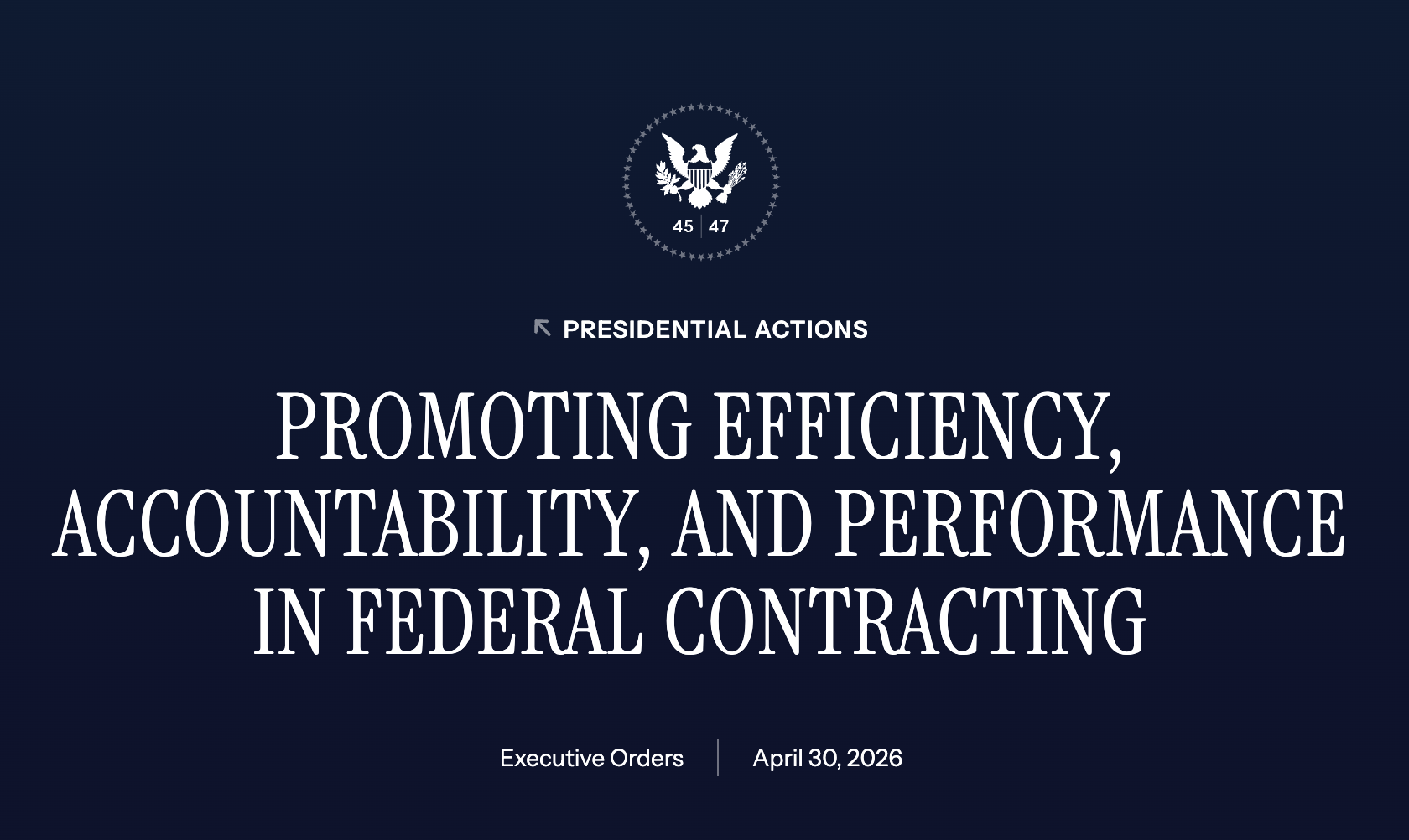
An Executive Order (E.O.) signed at the end of April didn’t get a ton of attention in the news cycle, but it sparked immediate interest at Intact. The order, entitled Promoting Efficiency, Accountability, and Performance in Federal Contracting, was signed Thursday, April 30, 2026.

From where we’re sitting, this E.O., along with guidance in the Federal Acquisition Regulation (FAR), signal a significant shift not just in federal procurement, but in the services industry at large. And it’s one we’re excited for.

Executive Order

The E.O. mandates that it is the policy of the administration that “fixed-price contracts with performance-based considerations shall serve as the default and preferred method of procurement“, applying to executive branch departments and agencies.

Screenshot of the executive order from the White House website

The directive states, in part:

Many private-sector contracts focus on driving performance rather than ever-increasing costs, often dictating a fixed cost for a well-defined outcome. Fixed-price contracts (outcome-based contracts) are characterized by clearly defined outcomes and deliverables on predictable timelines for fixed prices that generally are not adjusted based on contractors’ costs, and often tie profit to the contractors’ performance, rewarding work that exceeds expectations and penalizing subpar performance. This performance-based model encourages contractors to control costs and expeditiously meet deliverables to maximize profits.

FAR Part 37 – Service Contracting

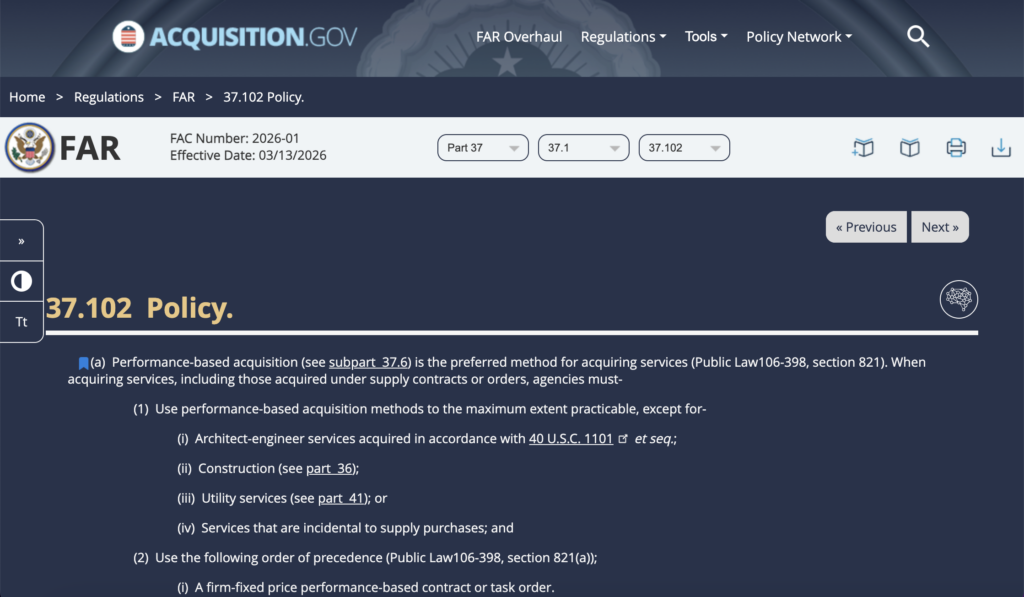
This is in alignment with guidance in the Federal Acquisition Regulation (FAR), Part 37, regarding Service Contracting. Part 37 echoes the recent E.O. stating that “performance-based acquisition is the preferred method for acquiring services.”

Screenshot of section 37.2 from the FAR website

Of particular note is subpart 37.6, which outlines the policies and procedures for Performance-Based Acquisition.

Among the requirements for these types of contracts are:

  • A performance work statement that describes “the work in terms of the required results rather than either ‘how’ the work is to be accomplished or the number of hours to be provided.”
  • The ability to assess work performance against measurable performance standards (e.g. results or outcomes).
So, what?

For professional services firms, this is a big deal. The E.O. signals a shift from the traditional models like Time & Materials (T&M) that have been the industry standard for decades.

For Intact, this means the federal government is prioritizing a model that we’ve been refining over the past 13 years: Outcome-Based Services.

The core elements of Outcome-Based Services have long aligned with federal Performance Based Acquisition standards and with this shift, our model now becomes the rule instead of the exception.

Among the key elements of Outcome-Based Services aligned with Performance Based Acquisition are:

  • Firm, Fixed Price Contracts: This means our price is agreed upon up front and we stay until the work is done, shifting the focus from hours billed to results delivered.
  • Clearly Defined Outcomes (also referred to as results, performance standards): Another guarantee of customer success is clearly defining what our customers want to accomplish up front and designing solutions to meet those goals.
  • Measurable Performance: We work with customers to establish realistic, achievable, and impactful goalposts and clearly defined metrics that tell us when we’ve reached them.

On the horizon, in alignment with the April 30 Executive Order, is scrutiny of existing contracts as each agency head has been directed to evaluate the top 10 non-fixed-price contracts for their respective agency and restructure, where possible, those contracts to comply with the order.

At Intact, we’re watching this moment unfold with genuine curiosity and optimism. After years of fine-tuning Outcome-Based Services, it’s encouraging to see the federal government formalize an approach we’ve long believed delivers better results: clearer expectations, accountable performance, and measurable value.