


Insights Article

The Customer Is the Only Metric That Matters

What 13 years of outcome-based engagement has taught me about how partners, vendors, and customers should actually work together.

Illustration of woman standing in front of panels with graphs and charts
Jesse White
Chief Executive Officer
Published
May 28, 2026

Behind every technology project, there is a person who vouched for it. Someone who stood up in front of a board, or a CIO, or a room of skeptical peers and said: trust me, this will work.

That person is spending something that never shows up in a budget: their own credibility. Of everything a project can cost, it is the hardest to pay back.

The traditional way our industry sells technology services spends that credibility carelessly.

Here is the pattern we typically see. By the time a customer calls us, we are usually not their first call, we’re the second.

The call comes after a traditional engagement, the kind sold in hours and deliverables instead of results, has drifted off course. After a platform has been customized into something no one can maintain. After a roadmap slipped one quarter, then two, then four. After the executive who sponsored the deal has to defend it to a room that stopped caring about the original business case long ago.

By then, the customer is not just frustrated, they have spent real money and real time. And they have spent that other thing, credibility. And that is one cost that cannot be paid back.

I have seen this so many times it is no longer a story, it is the shape of the market.

There is a different way to buy this work. Outcome-based engagement ties a provider’s pay and reputation to a defined business result, delivered in a set window of time, instead of solely to hours billed or features shipped.

I have worked inside that model for 13 years. Here is what it has taught me.
It started with ‘The Bank’

Ten years ago, one of our first outcome-based engagements was with a Fortune 200 bank based in New England. I will call it “The Bank.”

The Bank had hired the software manufacturer itself to do the implementation. On paper, that is the safe choice, the lowest risk in the room. In practice, the work was drifting from the outcome that was actually needed, the platform was being customized beyond usefulness, and the original business case was eroding while everyone watched.

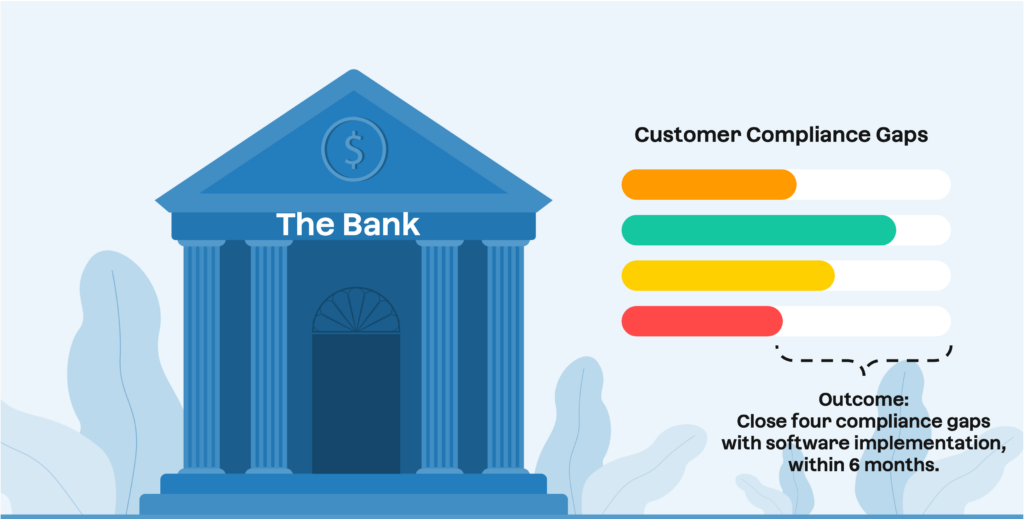
And, for The Bank, the business case was not abstract. They had four compliance gaps that were holding back growth. Regulatory exposure set the ceiling on what the institution could do next.

Illustration of a bank with four bars representing compliance gaps

So, when we came in, we did not open with software features or implementation milestones. We opened with one goal: close the gaps and unlock the growth they were holding hostage.

We laid out the outcome-based model, and the managed service that would carry the outcome past go-live, because driving toward an outcome does not end with deployment. We won the deal over two of the largest consultancies in the world, both selling the traditional approach: consult, then consult some more, then complete.

Then we put our own skin in the game. A significant percentage of the deal value was on the line. We would not see a dollar of it unless all four gaps closed in six months. It felt big at the time.

It also felt right.

The contract gave us six months; we closed the gaps in five.

That was not an exception, it is what an outcome-based contract is built to do. Every one of these contracts is an agreement about a defined result inside a fixed window of time. Once both sides are pointed at the result instead of a task list, you stop negotiating scope and start agreeing on the fastest, truest path to the finish.

That engagement with The Bank made something clear, and the 10 years since have only sharpened it:

The customer is not a stakeholder in the engagement. The customer is who it is for, the one who decides whether it worked, and a partner the whole way through.

What changes when the customer defines success

So, what does that mean in practice? It means the customer’s outcome is what everyone is organized around, paid against, and measured by; not the project plan, not the statement of work, not the software. The result the customer needs becomes the center of gravity, and every other relationship in the delivery chain has to bend toward it.

Vendors stop selling licenses and start co-owning the result. The partner stops billing hours and starts answering for whether the business outcome lands. The customer stops managing a project and starts holding everyone in the room, including themselves, accountable to the only outcome that matters.

This is uncomfortable at first. For everyone.

The reward for sitting with that discomfort is honest work. Conversations get faster. Course corrections happen in weeks, not months. The question that should have been asked on day one, “Are we actually moving the business?”, becomes the only one anyone is allowed to ask.

First call, not the cleanup crew

Here is what I want for this industry, and I will say it plainly. For outcome-based services to shift from backup plan to the default model.

The goal of the outcome shift is not to be the rescue option, after the first provider has burned through a customer’s patience, budget, and credibility. The goal is to be the first call.

That is a high bar, and meeting it is on all parties: partners, vendors, and customers, together.

The customer is the only metric that matters. Everything else is a means to that end.

It takes partners willing to put their own fees at risk against the customer’s outcome. It takes vendors willing to stand inside the delivery instead of waving from the sidelines. And it takes customers willing to demand a different model, loudly enough that the industry has no choice but to answer.

We have spent 13 years building toward that bar. The Bank was not a one-off. It was the template. Every outcome we have delivered since has reinforced the same lesson: when the customer sits at the center, everyone in the room does better work.

The customer is the only metric that matters. Everything else is a means to that end.