

Insights Article

The Customer Is the Only Metric That Matters

What 13 years of outcome-based engagement has taught me about how partners, vendors, and customers should actually work together.

Illustration of woman standing in front of panels with graphs and charts
Jesse White
Chief Executive Officer
Published
May 28, 2026

Behind every technology project, there is a person who vouched for it. Someone who stood up in front of a board, or a CIO, or a room of skeptical peers and said: trust me, this will work.

That person is spending something that never shows up in a budget: their own credibility. Of everything a project can cost, it is the hardest to pay back.

The traditional way our industry sells technology services spends that credibility carelessly.

Here is the pattern we typically see. By the time a customer calls us, we are usually not their first call, we’re the second.

The call comes after a traditional engagement, the kind sold in hours and deliverables instead of results, has drifted off course. After a platform has been customized into something no one can maintain. After a roadmap slipped one quarter, then two, then four. After the executive who sponsored the deal has to defend it to a room that stopped caring about the original business case long ago.

By then, the customer is not just frustrated, they have spent real money and real time. And they have spent that other thing, credibility. And that is one cost that cannot be paid back.

I have seen this so many times it is no longer a story, it is the shape of the market.

There is a different way to buy this work. Outcome-based engagement ties a provider’s pay and reputation to a defined business result, delivered in a set window of time, instead of solely to hours billed or features shipped.

I have worked inside that model for 13 years. Here is what it has taught me.
It started with ‘The Bank’

Ten years ago, one of our first outcome-based engagements was with a Fortune 200 bank based in New England. I will call it “The Bank.”

The Bank had hired the software manufacturer itself to do the implementation. On paper, that is the safe choice, the lowest risk in the room. In practice, the work was drifting from the outcome that was actually needed, the platform was being customized beyond usefulness, and the original business case was eroding while everyone watched.

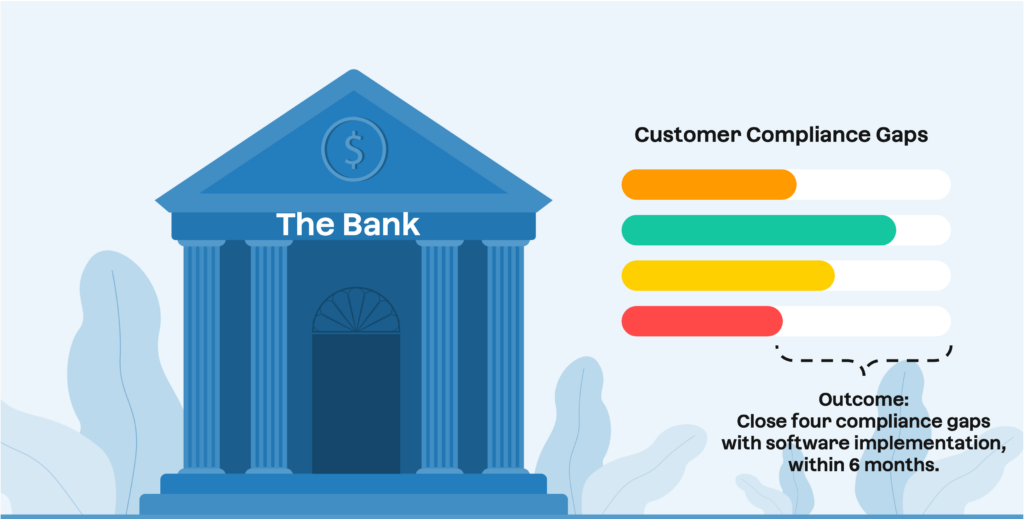
And, for The Bank, the business case was not abstract. They had four compliance gaps that were holding back growth. Regulatory exposure set the ceiling on what the institution could do next.

Illustration of a bank with four bars representing compliance gaps

So, when we came in, we did not open with software features or implementation milestones. We opened with one goal: close the gaps and unlock the growth they were holding hostage.

We laid out the outcome-based model, and the managed service that would carry the outcome past go-live, because driving toward an outcome does not end with deployment. We won the deal over two of the largest consultancies in the world, both selling the traditional approach: consult, then consult some more, then complete.

Then we put our own skin in the game. A significant percentage of the deal value was on the line. We would not see a dollar of it unless all four gaps closed in six months. It felt big at the time.

It also felt right.

The contract gave us six months; we closed the gaps in five.

That was not an exception, it is what an outcome-based contract is built to do. Every one of these contracts is an agreement about a defined result inside a fixed window of time. Once both sides are pointed at the result instead of a task list, you stop negotiating scope and start agreeing on the fastest, truest path to the finish.

That engagement with The Bank made something clear, and the 10 years since have only sharpened it:

The customer is not a stakeholder in the engagement. The customer is who it is for, the one who decides whether it worked, and a partner the whole way through.

What changes when the customer defines success

So, what does that mean in practice? It means the customer’s outcome is what everyone is organized around, paid against, and measured by; not the project plan, not the statement of work, not the software. The result the customer needs becomes the center of gravity, and every other relationship in the delivery chain has to bend toward it.

Vendors stop selling licenses and start co-owning the result. The partner stops billing hours and starts answering for whether the business outcome lands. The customer stops managing a project and starts holding everyone in the room, including themselves, accountable to the only outcome that matters.

This is uncomfortable at first. For everyone.

The reward for sitting with that discomfort is honest work. Conversations get faster. Course corrections happen in weeks, not months. The question that should have been asked on day one, “Are we actually moving the business?”, becomes the only one anyone is allowed to ask.

First call, not the cleanup crew

Here is what I want for this industry, and I will say it plainly. For outcome-based services to shift from backup plan to the default model.

The goal of the outcome shift is not to be the rescue option, after the first provider has burned through a customer’s patience, budget, and credibility. The goal is to be the first call.

That is a high bar, and meeting it is on all parties: partners, vendors, and customers, together.

The customer is the only metric that matters. Everything else is a means to that end.

It takes partners willing to put their own fees at risk against the customer’s outcome. It takes vendors willing to stand inside the delivery instead of waving from the sidelines. And it takes customers willing to demand a different model, loudly enough that the industry has no choice but to answer.

We have spent 13 years building toward that bar. The Bank was not a one-off. It was the template. Every outcome we have delivered since has reinforced the same lesson: when the customer sits at the center, everyone in the room does better work.

The customer is the only metric that matters. Everything else is a means to that end.

Insights Article

What is an Outcome?

Everyone uses the word, almost no one defines it the same way

Illustration with people following various paths, one path leads straight to a destination marked by a pin
Jesse White
Chief Executive Officer
Published
May 27, 2026

Walk into any meeting in technology services this year, and someone will say the word “outcome” in the first five minutes. It is on every slide, it ends every sentence, it is in the title of every panel.

Now, ask three people in the room to define it and you will get three different answers. The CIO will define it one way, the CFO another, the head of operations a third. The provider across the table will quietly use whichever definition makes their last engagement look like a win.

Until we are using the same word the same way, the rest of the conversation is theater.

A working definition

Here is a definition, plainly, in one sentence:

An outcome is a measurable business result, attributable to specific work, achieved inside a defined window of time.

The whole thing consists of these four pieces:

    1. A result the business cares about.
    2. A number you can put against it.
    3. Attribution to the work that was done.
    4. A deadline.

If any of the four is missing, you do not have an outcome. You have a hope.

Outcome is not output, and it is not a deliverable

This is where most consulting contracts quietly go off the rails.

An output is something the provider produced. A deliverable is something the provider handed over. An outcome is something that happened to your business.

Watch the difference:

“We deployed Workday.”
That is an output.

“We reduced HR ticket volume by 40% within 90 days of go-live, against the baseline we set in week one.”
That is an outcome.

Or this:

“We delivered an AI strategy roadmap.”
That is a deliverable.

“We removed 20,000 hours of manual triage work from named operations roles by the end of Q2.”
That is an outcome.

Or:

“We migrated to ServiceNow ITSM.”
That is an output.

“We cut average ticket resolution from four days to one day within six months, measured against the baseline taken the week we went live.”
That is an outcome.


You can ship every output and every deliverable in the contract and still produce no outcome. Most engagements do exactly that. The customer is paying for activity and the business is hoping that activity adds up to a result.

How an outcome becomes real

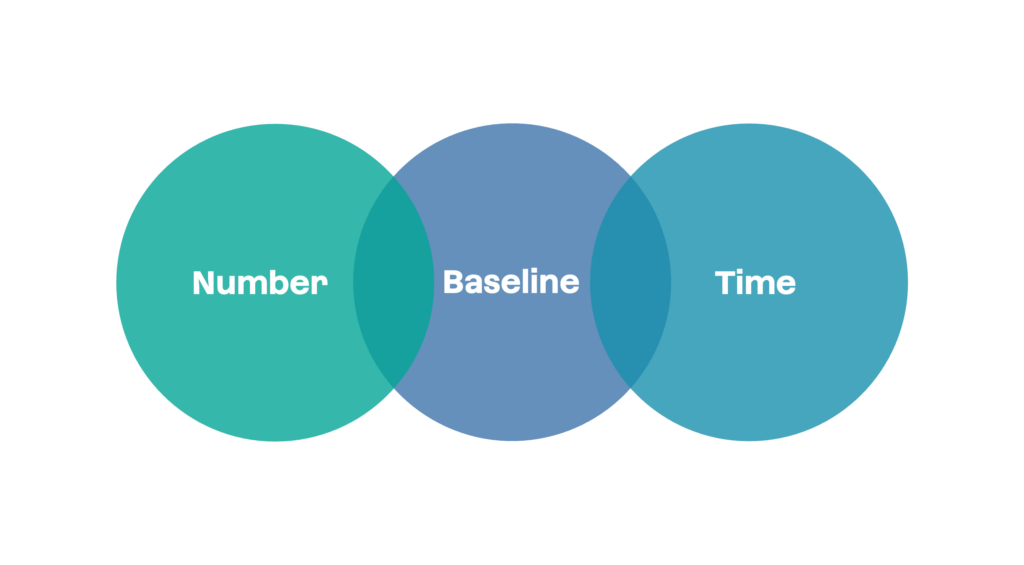
Three circles with Number, baseline, and time as the parts of an outcome.

Reaching an outcome requires three things to make it measurable:

    1. It needs a number. “Improve the service desk” is not an outcome. “Move first-contact resolution from 62% to 80%” is.
    2. It needs a baseline. You cannot improve something without knowing where it started. The baseline is where a partner says, in writing, “this is where you are today.”
    3. It needs a window of time. “Eventually” is not a window. “Within six months of go-live” is.

A common objection here is “we are standing up a brand new capability, so there is no baseline.” Fine. That is not an excuse to skip the number. Take an industry benchmark, pick a credible target, and commit to it.

A new internal support function with no historical NPS is not a reason to leave NPS out of the contract. It is a reason to write down a target like 50 and stand behind it. A real partner does not hide behind missing data; they get the data.

Why this matters to the buyer

This is not a vocabulary lesson. It is a buying lesson.

When a provider is paid for outputs, they ship outputs because that is what their incentive looks like. Every hour billed, every deliverable shipped, every milestone hit, registers as success for them, even if your business has not moved.

When a provider is paid for outcomes, the math changes. Their incentive and yours point in the same direction. Meet the number, get paid. Miss it, do not.

That is the entire reason the word “outcome” matters. Not because “outcome” is a better label than “deliverable.” Because tying the contract to a business result is the only way to make sure the work, the money, and your result are all pointing at the same thing.

An output is something the provider produced. An outcome is something that happened to your business.

A test you can run today

Open your current statement of work. Find the section that describes what you are paying for.

Count the verbs. “Deliver,” “build,” “configure,” “deploy,” “implement,” “stand up,” “design,” “produce.” Those are outputs. They describe motion.

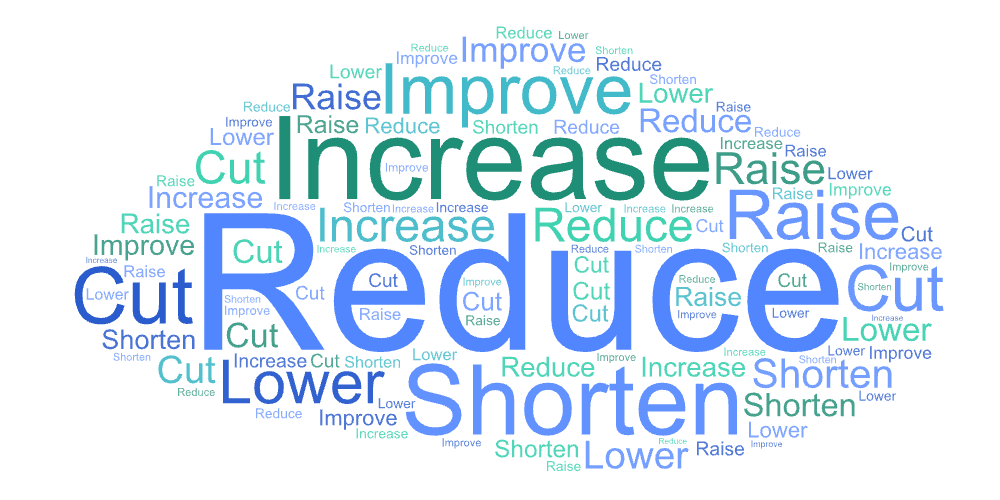
Word cloud graphic with outcome-related words

Now look for the verbs that describe a result. “Reduce,” “increase,” “raise,” “lower,” “cut,” “shorten,” “improve to,” followed by a number, a baseline, and a window. Those describe outcomes.

If the contract is mostly the first list, you bought motion. If it is mostly the second list, you bought a result. Most contracts in this industry are still largely composed of the first list. That is the gap this whole conversation is trying to close.

So next time someone says “outcome”

If three people in your meeting cannot define the same outcome the same way, you have not named one yet. Pick the result. Name the number. Set the window. Then ask the provider whether they will stand behind it.

That is what an outcome is. Everything else is a deliverable wearing a better word.


Frequently asked questions

What is an outcome in technology and consulting services?
An outcome is a measurable business result, attributable to specific work, achieved inside a defined window of time. The four pieces are: a result the business cares about, a number, attribution to the work that produced it, and a deadline.

What is the difference between an outcome and an output?
An output is something the provider produced. An outcome is something that happened to your business. “We deployed Workday” is an output. “We reduced HR ticket volume by 40 percent within 90 days” is an outcome.

What is the difference between an outcome and a deliverable?
A deliverable is something the provider hands over, often a document or artifact like a strategy roadmap. An outcome is the business result that deliverable was supposed to produce. You can ship every deliverable in the contract and still produce no outcome.

How do you measure an outcome when there is no historical baseline?
Take a credible industry benchmark and commit to a target. The absence of a baseline is not a reason to skip the number, it is a reason to set one. A real partner will write the target down and stand behind it.

Insights Article

Our Preferred Contracting Model Is Now the Federal Standard

The call for fixed-price contracting and measurable outcomes

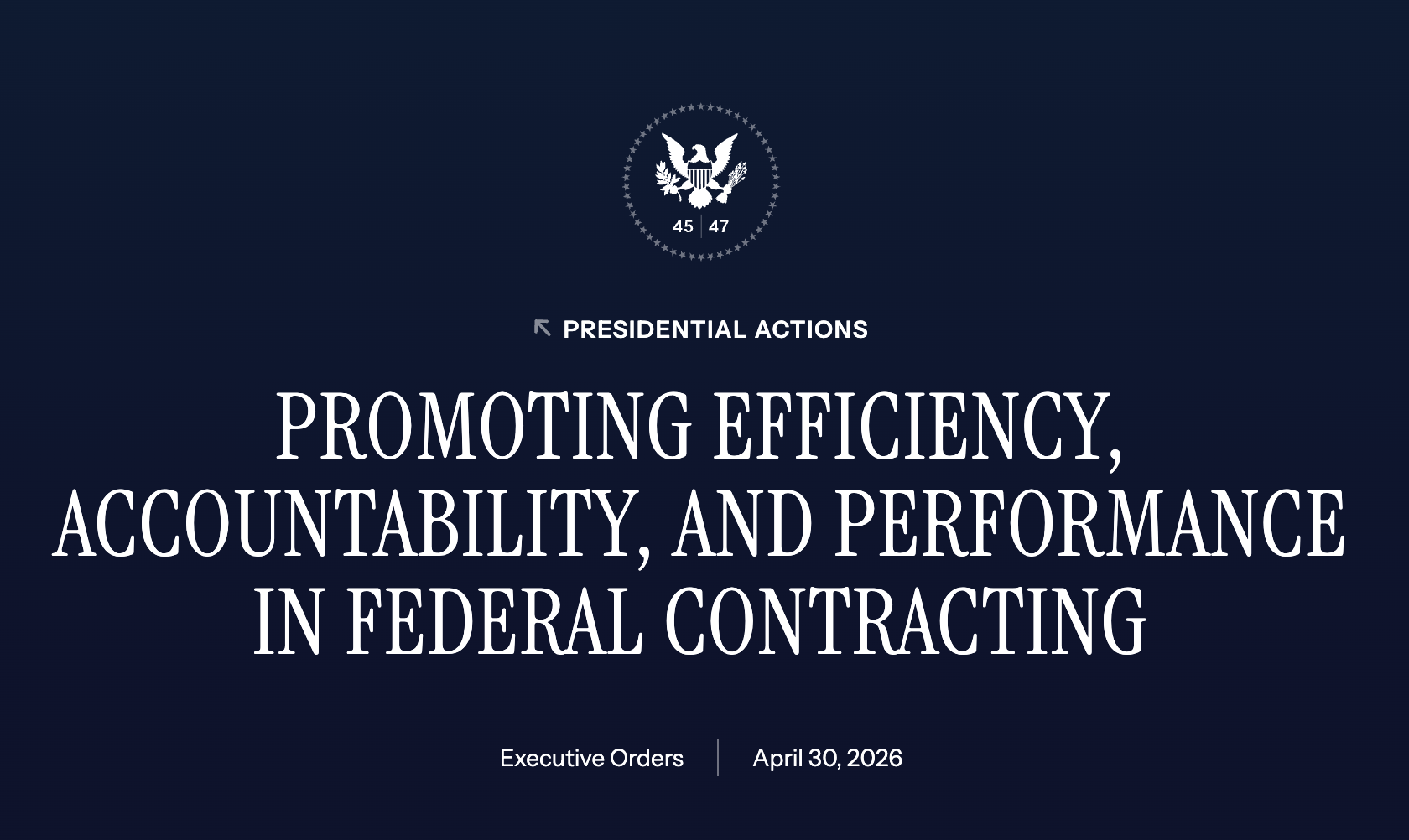
An Executive Order (E.O.) signed at the end of April didn’t get a ton of attention in the news cycle, but it sparked immediate interest at Intact. Executive Order 14402, entitled Promoting Efficiency, Accountability, and Performance in Federal Contracting, was signed Thursday, April 30, 2026.

From where we’re sitting, this E.O., along with guidance in the Federal Acquisition Regulation (FAR), signal a significant shift not just in federal procurement, but in the services industry at large. And it’s one we’re excited for.

Executive Order

E.O. 14402 mandates that it is the policy of the administration that “fixed-price contracts with performance-based considerations shall serve as the default and preferred method of procurement“, applying to executive branch departments and agencies.

Screenshot of the executive order from the White House website

The directive states, in part:

Many private-sector contracts focus on driving performance rather than ever-increasing costs, often dictating a fixed cost for a well-defined outcome. Fixed-price contracts (outcome-based contracts) are characterized by clearly defined outcomes and deliverables on predictable timelines for fixed prices that generally are not adjusted based on contractors’ costs, and often tie profit to the contractors’ performance, rewarding work that exceeds expectations and penalizing subpar performance. This performance-based model encourages contractors to control costs and expeditiously meet deliverables to maximize profits.

FAR Part 37 – Service Contracting

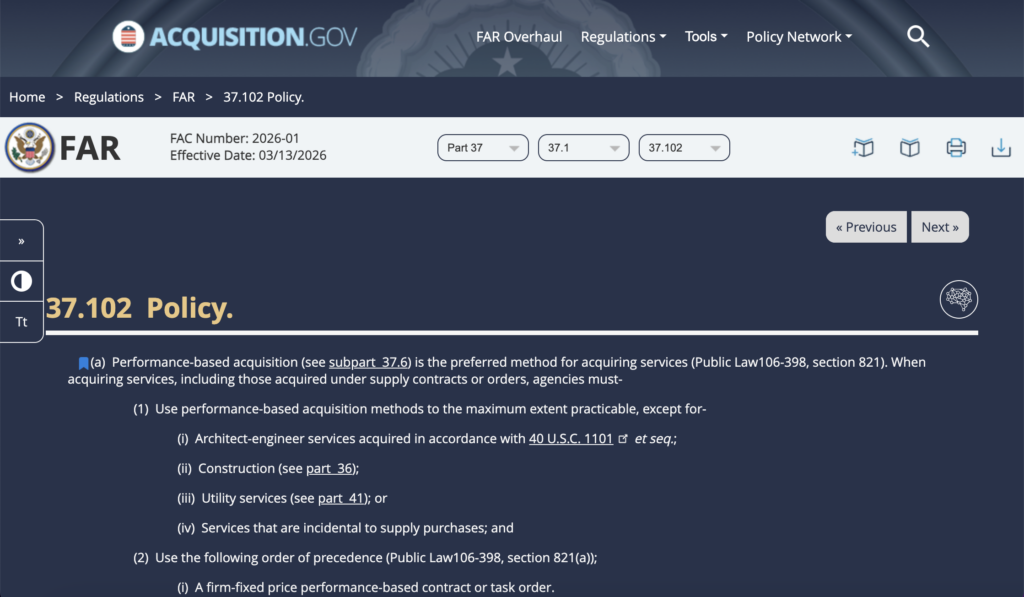
This is in alignment with guidance in the Federal Acquisition Regulation (FAR), Part 37, regarding Service Contracting. Part 37 echoes the recent E.O. stating that “performance-based acquisition is the preferred method for acquiring services.”

Screenshot of section 37.2 from the FAR website

Of particular note is subpart 37.6, which outlines the policies and procedures for Performance-Based Acquisition.

Among the requirements for these types of contracts are:

  • A performance work statement that describes “the work in terms of the required results rather than either ‘how’ the work is to be accomplished or the number of hours to be provided.”
  • The ability to assess work performance against measurable performance standards (e.g. results or outcomes).
So, what?

For professional services firms, this is a big deal. E.O. 14402 signals a shift from the traditional models like Time & Materials (T&M) that have been the industry standard for decades.

For Intact, this means the federal government is prioritizing a model that we’ve been refining over the past 13 years: Outcome-Based Services.

The core elements of Outcome-Based Services have long aligned with federal Performance Based Acquisition standards and with this shift, our model now becomes the rule instead of the exception.

Among the key elements of Outcome-Based Services aligned with Performance Based Acquisition are:

  • Firm, Fixed Price Contracts: This means our price is agreed upon up front and we stay until the work is done, shifting the focus from hours billed to results delivered.
  • Clearly Defined Outcomes (also referred to as results, performance standards): Another guarantee of customer success is clearly defining what our customers want to accomplish up front and designing solutions to meet those goals.
  • Measurable Performance: We work with customers to establish realistic, achievable, and impactful goalposts and clearly defined metrics that tell us when we’ve reached them.

On the horizon, in alignment with the April 30 Executive Order, is scrutiny of existing contracts as each agency head has been directed to evaluate the top 10 non-fixed-price contracts for their respective agency and restructure, where possible, those contracts to comply with the order.

At Intact, we’re watching this moment unfold with genuine curiosity and optimism. After years of fine-tuning Outcome-Based Services, it’s encouraging to see the federal government formalize an approach we’ve long believed delivers better results: clearer expectations, accountable performance, and measurable value.